ಮನೆಗೆ ಯಾವ ಇನ್ವರ್ಟರ್ ಮತ್ತು ಬ್ಯಾಟರಿ ಬೇಕು?
How to choose an inverter and battery for your home
When someone asks us for "a good inverter", our first question is: what do you want running during a cut, and for how long? Those two answers decide almost everything.
Add up what you want running
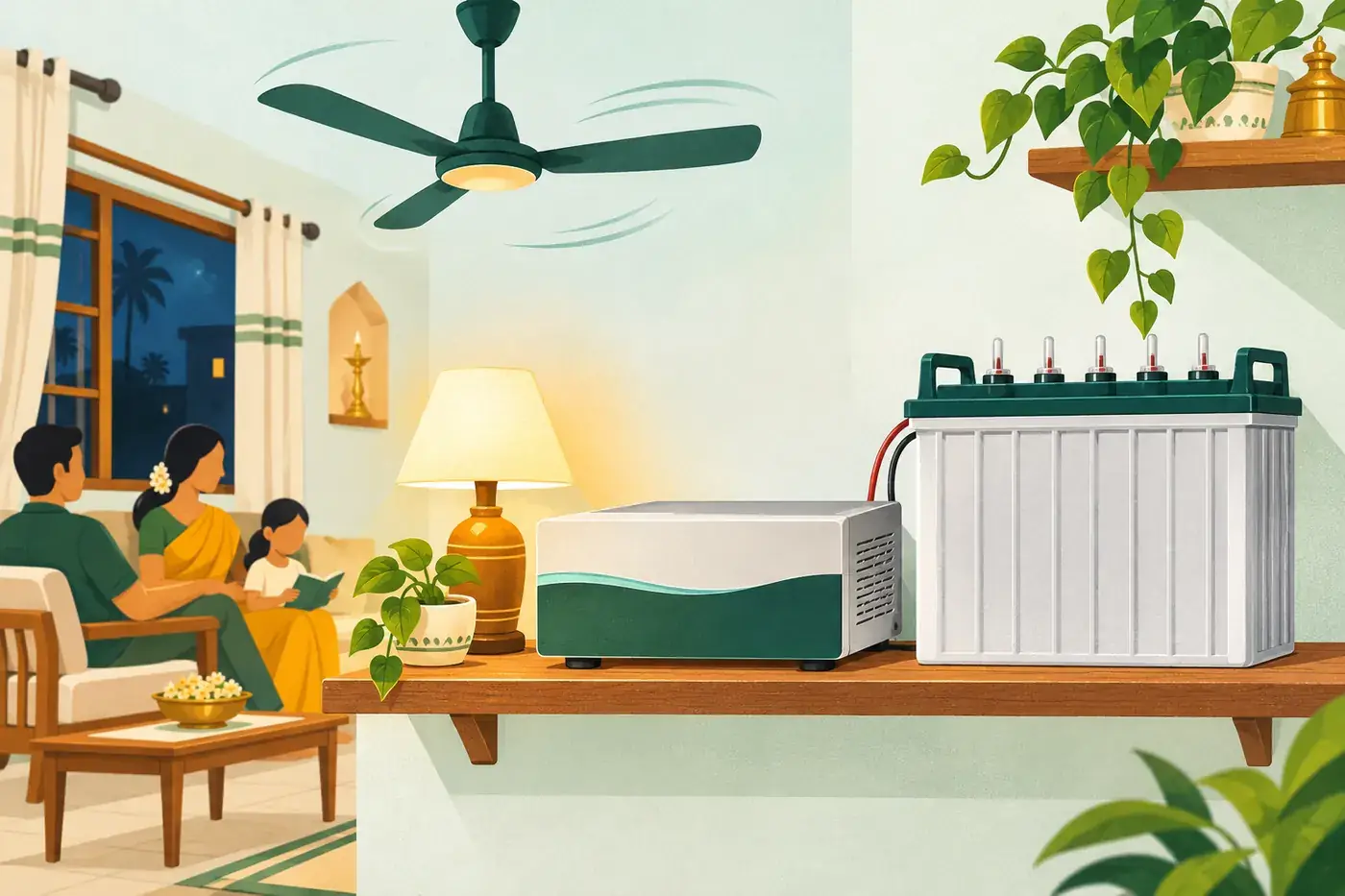
List the things that must work when the power goes. In most Davangere homes that's three or four fans, a few LED lights, the TV and the Wi-Fi router, which comes to about 300–400 watts.
For a rough inverter size, add a quarter for headroom and divide by 0.8 (a typical power factor). A 400 W load works out to about 625 VA, so an 800–1,100 VA unit is comfortable. A fridge or a water pump needs a bigger unit, because motors pull several times their running power for a moment when they start.
- Ceiling fan: 60–75 W (BLDC fan: about 30 W)
- LED bulb or tube light: 9–20 W
- LED TV: 60–100 W
- Wi-Fi router: about 10 W
- Fridge: 150–250 W running, with a big surge at start-up
Things a small home inverter shouldn't run
Geysers, irons, induction stoves, mixer-grinders and borewell pumps are too heavy for a 900–1,100 VA package. Plug them into the normal supply, not the inverter line.
How long a 150 Ah battery really lasts
A 12 V, 150 Ah battery holds about 1,800 watt-hours on paper. You shouldn't drain a lead-acid battery to empty every day, and the inverter loses some power along the way, so only part of that reaches your fans and lights.
In practice that's about 2½ to 4 hours for a 300 W load, at the lower end as the battery ages. If cuts in your area run longer, go up to a 200 Ah battery, or to a 24 V system with two 150 Ah batteries, which stores about twice as much as one. Keep heavy loads off the inverter line.
Tubular or flat plate?
If the power goes most days, we'd normally put you on a tall tubular battery (ಟ್ಯೂಬ್ಯುಲರ್ ಬ್ಯಾಟರಿ). It copes better with daily charging and discharging, and the ones we stock carry 48–60 month warranties. If cuts are occasional, a cheaper flat-plate battery can be enough.
Sine wave or square wave?
Sine wave inverters give power that's close to the mains supply. Fans run quieter and cooler, and they're the safer choice for BLDC fans, TVs, routers, chargers and fridges. Square wave models such as the Luminous Eco Watt Neo cost less but can make motors hum. For a mix of electronics, spend the extra on sine wave.
Many home units have a UPS mode that switches over fast enough for a desktop computer, but this varies by model. Check before you buy if a restart is unacceptable.
Prices at our shop
Listed prices before GST. Installation, cable and trolley are quoted with your order, and you can ask what we'll give for your old battery.
- Luminous Eco Watt Neo 1050 VA inverter (square wave): ₹6,900
- Microtek 24x7 HB 1075 UPS: ₹7,870
- V-Guard UPS battery 145 Ah: ₹13,275
- Microtek inverter battery 150 Ah, 48 months: ₹14,640
- Luminous inverter battery 150 Ah, 60 months: ₹15,810
- Exide inverter battery 150 Ah, 60 months: ₹16,612
Looking after the battery
Keep it somewhere airy, out of children's reach, not in a closed cupboard or a hot veranda. Check the water level as the manufacturer recommends and top up only with distilled water (ಡಿಸ್ಟಿಲ್ಡ್ ನೀರು), never tap or RO water. Keep it charged, and avoid running it flat again and again: deep discharges shorten its life.